

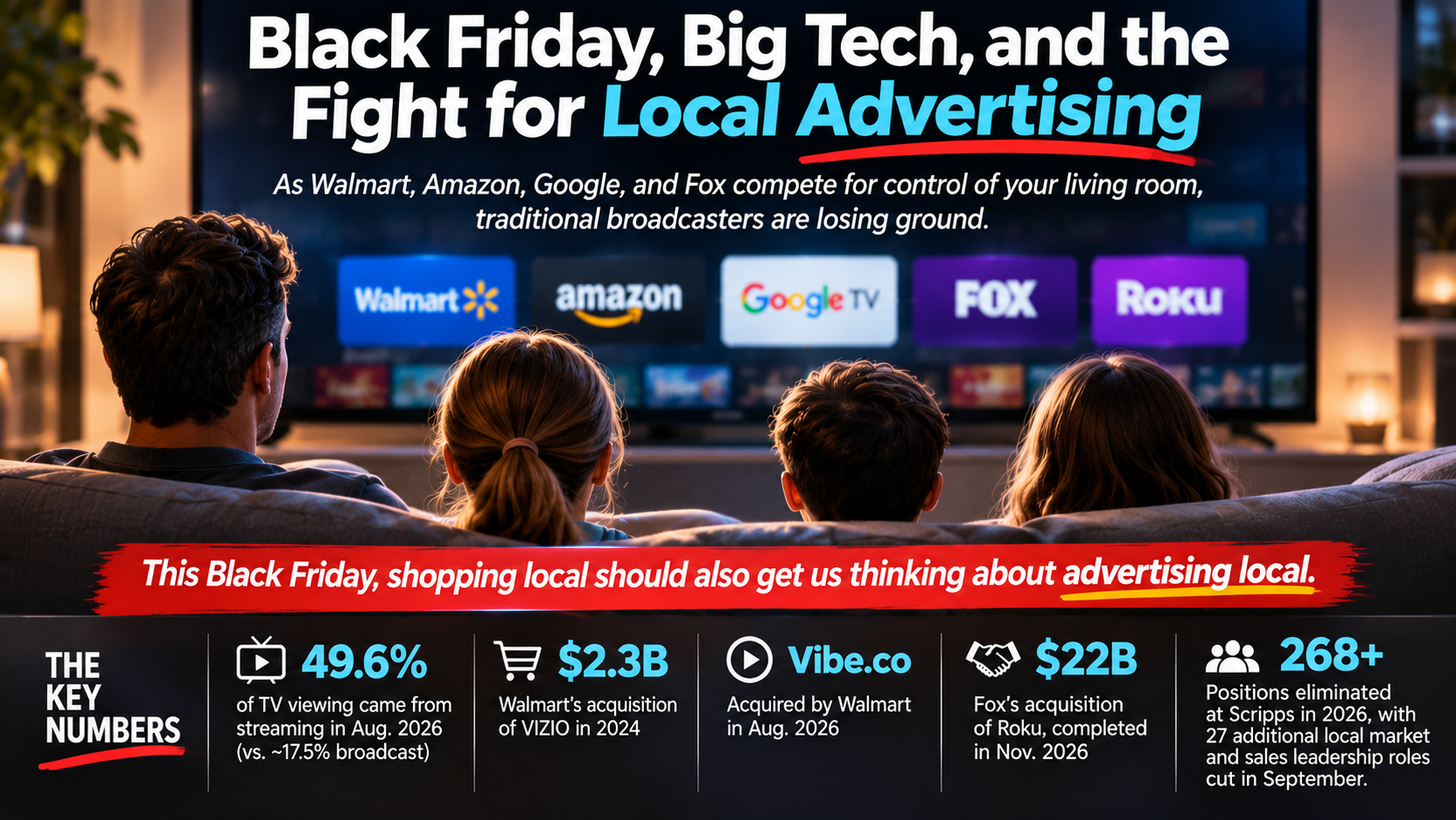
As Walmart, Amazon, Google, and Fox compete for control of your living room, traditional broadcasters are losing ground. This Black Friday, shopping local should also get us thinking about advertising local.
Every Black Friday, we’re encouraged to shop local, support small businesses, and keep our dollars in the communities where we live. It’s a message I believe in. But as we head into another holiday shopping season, I’ve been thinking about something else. What about advertising local?
While we’re encouraging consumers to support neighborhood retailers, some of the largest companies in the world are competing for control of how those same consumers discover products, watch television, and ultimately decide where to spend their money. Walmart, Amazon, Google, and Fox are all making major moves in advertising, and the competition isn’t simply about selling more products or attracting more viewers. It’s about controlling the screen in your living room, the relationship with the consumer, and the advertising dollars that follow.
I Saw This Coming, Just Not Who Would Be Leading It
Before I started Enradius, I worked at E.W. Scripps, and even back then I could see that the traditional television advertising business was going to change. For decades, local television stations built their businesses around relationships with major networks, local programming, and advertisers. The networks delivered the shows people wanted to watch, local stations delivered the audiences, and sales teams built relationships with businesses in their communities. I believed streaming would eventually disrupt that model. At the time, I thought Netflix would be the company that changed everything, challenging the networks and their long-standing relationships with local broadcasters.
What I didn’t anticipate was Walmart, Google, and Amazon becoming such powerful players in controlling the television experience itself. Think about that. A retailer, a search engine, and an e-commerce company are now among the companies competing to influence what appears on your television screen. And they’re not just interested in what you’re watching. They’re interested in what you’re buying. The television has become more than an entertainment device. It’s an advertising platform, a source of consumer information, and increasingly, a place where shopping decisions are made.
Walmart, Amazon, Google, and Fox Want Your Living Room
Walmart has been building one of the most interesting advertising businesses in the country through Walmart Connect. Unlike traditional media companies, Walmart has an enormous advantage. It knows what millions of consumers are purchasing, both in stores and online. In 2024, Walmart acquired television manufacturer VIZIO for approximately $2.3 billion, gaining access to its connected television operating system and advertising business. Then, in August 2026, Walmart completed its acquisition of Vibe.co, a self-service connected television advertising platform designed to make streaming advertising easier for businesses of all sizes.
Combine Walmart’s shopping data, advertising network, VIZIO’s television ecosystem, and Vibe.co’s advertising technology, and you begin to see the strategy. Walmart wants to connect what consumers watch with what they eventually purchase. Imagine a brand advertising a product during a streaming program and then being able to measure whether consumers purchased it at Walmart. That ability to connect advertising exposure with actual retail sales is a significant development, particularly as streaming advertising becomes more accessible to smaller and mid-sized businesses.
And Walmart isn’t alone. Fox Corporation completed its acquisition of Roku in November, combining its television programming, sports, news, and Tubi streaming service with one of the most widely used connected television platforms. Amazon is connecting entertainment directly to shopping through Prime Video, Fire TV, and interactive advertisements that allow viewers to explore products or add them to their carts. Google already has a substantial presence through YouTube, YouTube TV, Google TV, and its advertising technology.
What’s fascinating is that these companies are approaching television from entirely different directions. Walmart and Amazon are retailers becoming media companies. Google is extending its technology and advertising business into television. And Fox is a traditional media company investing in the technology that controls how viewers access content. They’re all fighting for the same thing: the consumer sitting at home.
The Numbers Behind the Battle
A few developments illustrate just how quickly the television and retail advertising businesses are changing:
- 49.6% of television viewing came from streaming in August 2026, compared with approximately 17.5% for traditional broadcast television, according to Nielsen.
- $2.3 billion: Walmart’s approximate acquisition price for VIZIO in 2024, giving it a connected television operating system and advertising platform.
- August 2026: Walmart completed its acquisition of Vibe.co, expanding its capabilities in self-service streaming television advertising.
- November 2026: Fox completed its acquisition of Roku, significantly expanding its connected television distribution and advertising capabilities.
- 268 positions: The approximate number of jobs eliminated in a Scripps restructuring earlier in 2026, followed by another 27 local market and sales leadership positions eliminated in September.
These aren’t isolated developments. They’re part of a much larger transformation in how television audiences are reached, how advertising is purchased, and who controls the technology connecting advertisers with consumers.
What Happens to Local Television and Local Advertising?
Here’s the part of the story that concerns me. People haven’t stopped watching television. They’ve changed how they watch it, and traditional local broadcasters are feeling the pressure. Look at what’s happening at E.W. Scripps, a company I know from personal experience. Scripps has been restructuring its local television operations, investing in streaming news, automating production workflows, and consolidating management responsibilities. Some stations have also moved away from traditional anchor-led newscasts toward reporter-driven, streaming-focused formats. Scripps has said these changes are intended to improve efficiency and preserve local journalism, but they also illustrate how dramatically the business is changing.
Local television was built around people who knew their communities. News anchors became familiar faces, reporters understood the neighborhoods they covered, and sales representatives knew the local car dealers, restaurants, furniture stores, and business owners who supported their stations. Today, more advertising can be purchased through programmatic platforms, where technology handles much of the buying process. Advertisers can select audiences, geographic locations, budgets, and campaign objectives without ever speaking to a local television sales representative.
I understand the advantages. I’ve spent years building a business around programmatic and location-based advertising. But there’s a difference between making advertising more efficient and losing the local relationships that helped build the industry. Programmatic buying isn’t the only reason traditional broadcasters are restructuring. Declining linear audiences, changing advertising budgets, and operating costs all play a role. Still, the irony is hard to ignore. The television audience hasn’t disappeared. Much of it has simply moved to platforms where local broadcasters no longer control the advertising relationship.
Shopping Local Should Mean Thinking About Advertising Local
This brings me back to Black Friday. Every year, we see campaigns encouraging consumers to support local retailers, restaurants, and small businesses. We talk about keeping money in the community and supporting the people who live and work around us. But how often do we have the same conversation about advertising?
When a local business spends money advertising through Amazon, Google, Walmart, or another national platform, that advertising may do an excellent job reaching local customers. And that’s important. But reaching local customers and supporting local media aren’t necessarily the same thing. A business can target consumers within five miles of its store while much of its advertising investment flows through a national technology company. That doesn’t make the advertising ineffective or the decision wrong. Businesses need results. But it raises an important question: what happens to the local newspapers, television stations, radio stations, and digital publishers that have historically helped connect communities when more advertising dollars move away from them?
I don’t think the answer is to stop using Google, Amazon, Walmart, or programmatic advertising. Far from it. I believe the opportunity is to use modern advertising technology while continuing to support local media. Programmatic advertising can help accomplish that by making local publisher and broadcaster inventory accessible through digital advertising platforms. Advertisers can reach geographically relevant audiences while supporting local content. But they need to pay attention to where their ads are running, not just who they’re reaching. A campaign that targets local consumers isn’t automatically supporting local media.
I’ve watched the advertising industry evolve from traditional media to search, social media, mobile advertising, and now connected television. Every transformation has created opportunities, but it has also changed who controls the relationship between businesses and consumers. Walmart is building an advertising ecosystem around retail purchases and connected television. Amazon is bringing shopping directly into entertainment. Google continues to connect search, video, and advertising. And Fox is investing heavily in the technology behind television viewing. Meanwhile, traditional local broadcasters are trying to reinvent businesses built around a different way of reaching audiences.
I expected streaming to disrupt television years ago. I just didn’t expect the companies leading the transformation to be retailers and technology platforms rather than the television networks themselves.
As we approach Black Friday, we should absolutely encourage consumers to shop local. But we should also encourage businesses and marketers to think about where their advertising dollars go, which media companies they support, and how they can use new technology without losing the local connections that matter. The future of advertising doesn’t have to be a choice between advanced technology and local communities. We should be working toward both.
This Black Friday, shopping local matters. But advertising local matters, too.
David Carberry is the founder of Enradius and Local Ad Networks, with more than 25 years of experience in media, advertising, and technology. His career includes leadership roles and experience with CBS Radio, Time Warner, Advertising.com/AOL, E.W. Scripps, Radio One, and Yext. Today, he focuses on helping businesses connect with local audiences through programmatic, digital, and location-based advertising, while advocating for the future of local media and community-based marketing.