

The next big battle for local business discovery may not happen on a search engine at all.
For years, when someone needed a plumber, a restaurant, a hotel, or just about any local business, the process was pretty simple. They Googled it.
Businesses spent years learning how to show up in those searches. We built websites, optimized Google Business Profiles, collected reviews, invested in SEO, and paid for Google Ads. And for good reason. That’s where customers were looking.
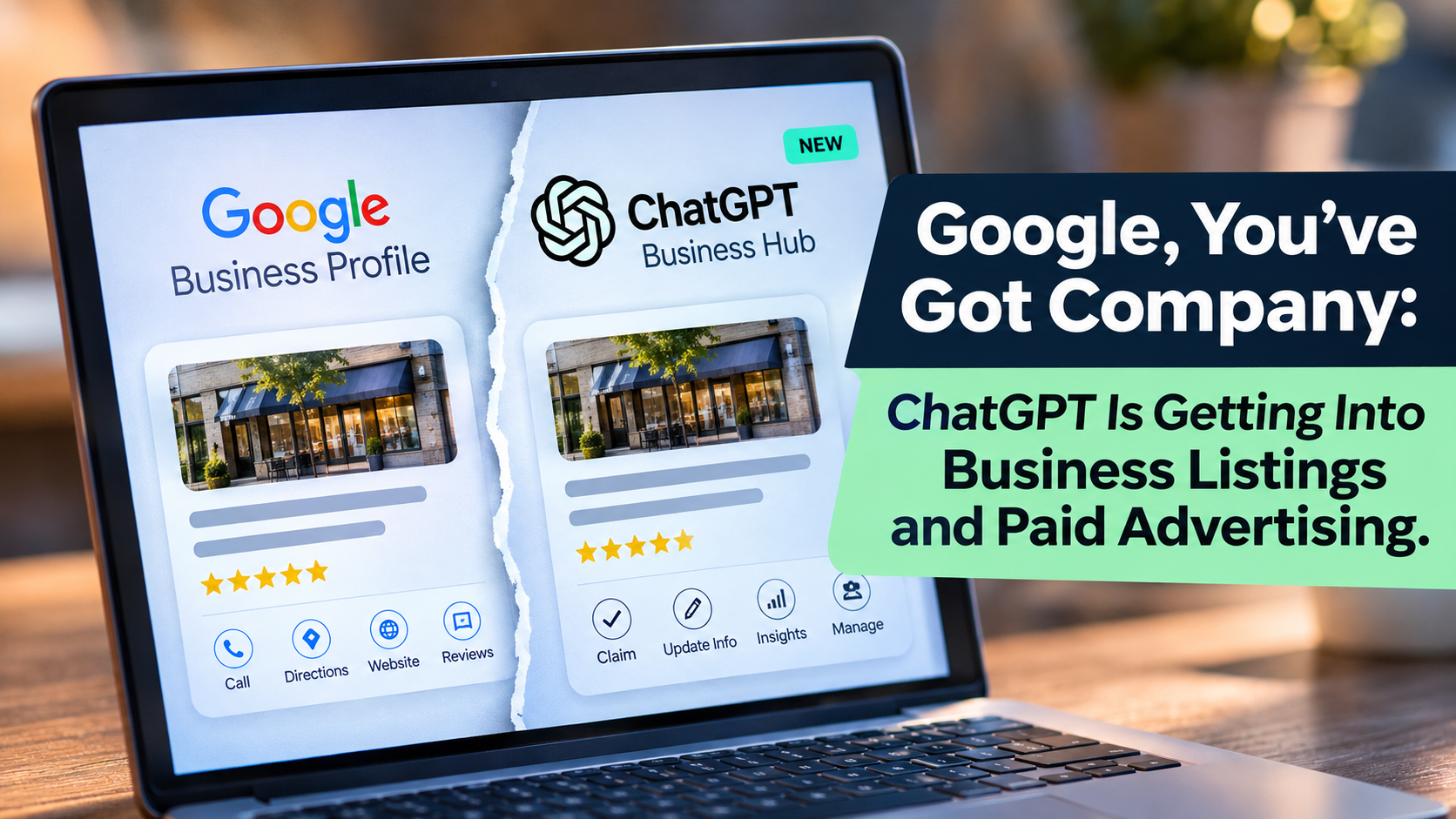
But something interesting is happening, and I think every business owner and marketer should be paying attention. ChatGPT is moving into Google’s backyard, and it’s bringing business listings and paid advertising with it.
OpenAI recently introduced Businesses in ChatGPT, a new feature that allows eligible businesses to claim their profiles, update information, and gain insights into how people are discovering them through ChatGPT.
Sound familiar? It should. Google Business Profile has been doing something similar for years.
What makes this particularly interesting is the type of information ChatGPT could provide businesses. Rather than simply seeing how many people found their listing, businesses may begin to understand the conversations and topics that led someone to discover them.
Think about that for a minute. A restaurant might learn that people are finding it while planning a date night, organizing a business dinner, or looking for a place to take the family. That’s a different level of insight into consumer intent than simply knowing someone searched for “restaurants near me.”
Now, before everyone starts celebrating the death of Google, let’s be realistic. This is still a developing product, and ChatGPT continues to rely on information from websites, Google Business Profiles, and other online sources. Claiming a profile doesn’t automatically mean your business will be recommended more often.
Google Business Profile is still incredibly important. But that doesn’t mean businesses should ignore what OpenAI is building.
And here’s where the story gets even more interesting. ChatGPT is also becoming an advertising platform.
OpenAI has been expanding advertising inside ChatGPT, introducing capabilities such as cost-per-click bidding, geographic targeting, and tools to help advertisers measure performance. It’s also exploring advertising experiences that go beyond a traditional sponsored link.
For those of us who have spent years in digital advertising, this is worth watching. Because the opportunity isn’t simply to display another ad. It’s to reach someone while they’re actively researching, comparing options, and making a decision.
Search Is Becoming a Conversation
Let’s use Ocean City, Maryland, as an example.
A traditional Google search might be “Ocean City hotels.” You get sponsored listings, maps, organic results, and travel websites. The consumer clicks around, compares options, and hopefully finds what they’re looking for.
But someone using ChatGPT might ask, “I’m taking my family to Ocean City for the weekend. We have two teenagers, want to be close to the boardwalk, need parking, and would prefer a hotel with a pool. What are our best options?”
That’s not just a keyword search. That’s a conversation filled with information about what the consumer actually wants.
And it doesn’t stop there. The next question might be about restaurants within walking distance, activities for teenagers, or which hotels offer the best value.
Suddenly, hotels, restaurants, attractions, and entertainment venues all have opportunities to become part of that conversation.
We’re moving from businesses trying to match keywords to businesses trying to become part of the answer.
That’s a significant change in how consumers discover local businesses.
And when you combine that type of consumer intent with an advertising platform, you can begin to see why this could become a major opportunity for marketers. Imagine being able to reach someone who isn’t simply searching for a destination, but is actively planning a trip, comparing hotels, and deciding where to spend their money.
That’s a very different advertising environment from the one many businesses have grown accustomed to.
So, Should Google Be Worried?
I don’t think Google is going anywhere anytime soon. It has spent decades building an ecosystem around search, maps, reviews, business information, and advertising. That isn’t going to disappear because ChatGPT launched business profiles.
Google also has its own AI products and enormous resources to compete in this space.
But for years, Google has largely controlled how businesses are discovered online. If you wanted customers to find you, showing up on Google was practically mandatory.
Now consumers have another place to ask questions, compare businesses, and make purchasing decisions. And ChatGPT isn’t alone. Other AI platforms are changing how people discover information as well.
The question is no longer just where your business ranks on Google. It’s whether AI platforms know your business exists, understand what you offer, and consider you relevant when someone asks for a recommendation.
That’s why I believe businesses should start paying attention now, even if they’re not ready to spend advertising dollars on ChatGPT.
Make sure your Google Business Profile is accurate. Keep your website updated. Pay attention to reviews and the information appearing about your business across the internet. Look into claiming your business through ChatGPT’s new Business Hub if you’re eligible.
And here’s something simple anyone can do: open ChatGPT and start asking the questions your customers might ask. See whether your business appears, whether the information is accurate, and which competitors are being recommended.
You might be surprised by what you find.
Another Shift in Local Advertising
I’ve spent a good portion of my career watching how technology changes the relationship between businesses and consumers. We’ve gone from newspaper directories and Yellow Pages to websites, search engines, social media, mobile advertising, and location-based targeting.
Every shift created new opportunities. And every shift left some businesses wondering why their old marketing strategies weren’t working quite as well anymore.
I believe AI-powered discovery is another one of those shifts.
What makes this one different is that consumers aren’t necessarily looking for a list of websites anymore. They’re looking for answers. And increasingly, those answers include recommendations about where to go, what to buy, and who to do business with.
For local businesses, that’s both an opportunity and a challenge. The businesses that understand how to become part of those conversations may have an advantage over the ones that wait until everyone else figures it out.
Google isn’t going anywhere. But it may no longer be the only place that matters when someone is looking for your business.
And that alone is worth paying attention to.
David Carberry is the founder of Enradius and Local Ad Networks, with more than 25 years of experience in media, advertising, and technology. His career includes leadership roles and experience with CBS Radio, Time Warner, Advertising.com/AOL, E.W. Scripps, Radio One, and Yext. Today, he focuses on helping businesses connect with local audiences through programmatic, digital, and location-based advertising, while advocating for the future of local media and community-based marketing.