

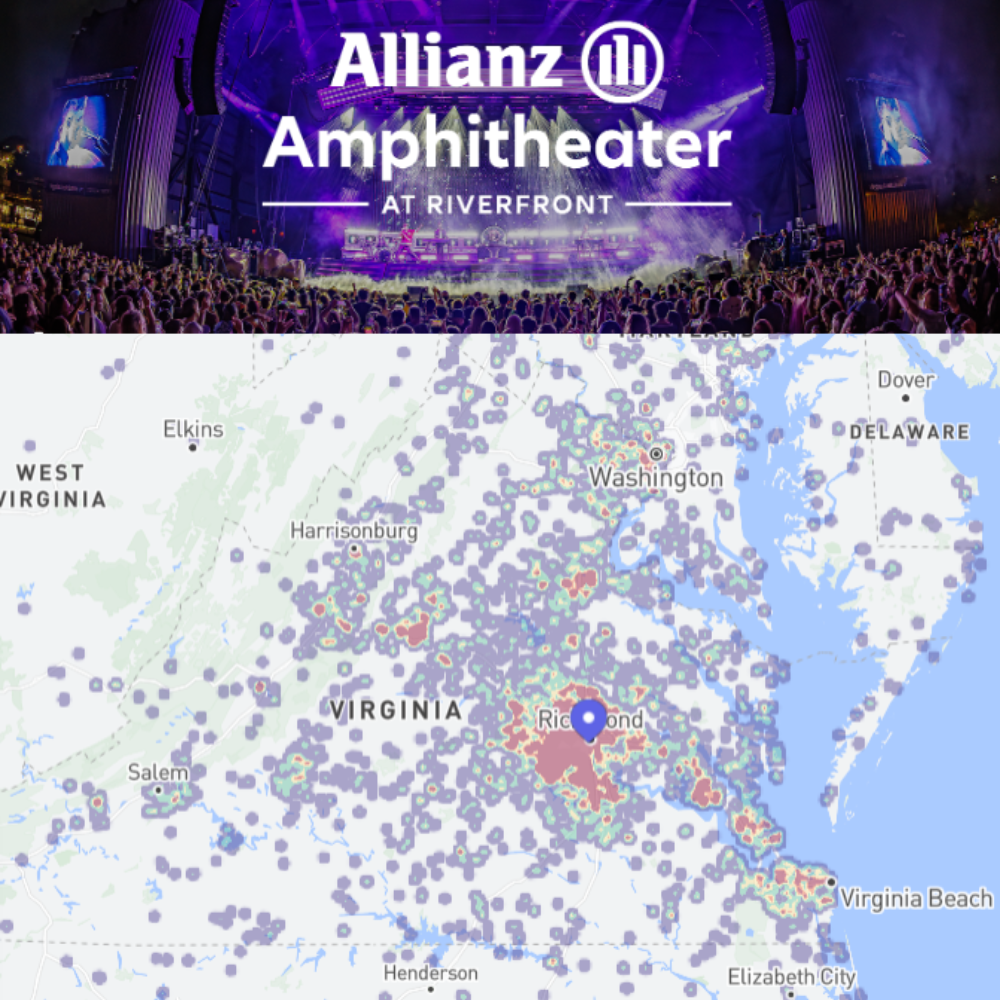
How Richmond’s newest concert venue generated more than 230,000 visits, moved audiences across the region, and revealed what businesses can learn from real-world behavior
More Than a Concert Venue — A Window Into Consumer Behavior
No, this isn’t a horror movie.
But if you own a business, market a destination, operate a restaurant, hotel, attraction, retail center, or simply want to better understand how consumers actually move through your market, understanding what people did last summer may be one of the smartest competitive advantages available today.
At Enradius, we have partnered with Placer.ai for more than five years to help businesses uncover real-world movement patterns through location intelligence and foot-traffic analytics.
Because marketing should not rely on assumptions.
It should reflect behavior.
And few examples illustrate this better than the first season of Allianz Amphitheater at Riverfront in Richmond, Virginia.
Officially opening on June 6, 2025, Allianz Amphitheater immediately became more than Richmond’s newest concert venue. It became a measurable case study in movement, visitation, and local economic activity — showing how entertainment influences restaurants, hotels, shopping, tourism, and surrounding business ecosystems.
During its inaugural season, from May 31 through September 20, 2025, Allianz Amphitheater generated approximately 230,500 visits from more than 180,300 unique visitors, creating a powerful new pattern of consumer activity in the Richmond market.
But the real story is not simply attendance.
The story is movement.
Because movement tells stories.
A Venue Worth Traveling For
Of course, movement does not happen in a vacuum.
People travel for experiences.
And Allianz Amphitheater’s inaugural season delivered a lineup that gave audiences a reason to make a night out — or even a weekend out — of a concert experience.
The venue welcomed major national acts spanning rock, country, folk, comedy, and classic hits, including:
- Dave Matthews Band
- Mumford & Sons
- Neil Young
- James Taylor
- Counting Crows
- Styx
- Brad Paisley
- Dwight Yoakam
- Boyz II Men
- Kansas
- 38 Special
- Steve Martin & Martin Short
- Richmond’s own Lamb of God
When audiences are willing to drive 10, 30, 50, or even 100+ miles for entertainment, the experience rarely starts and ends with the concert itself.
People grab dinner.
They meet friends.
They visit nearby destinations.
Some stay overnight.
Others turn a show into an entire evening downtown.
That is where the data becomes fascinating — because movement reveals not just attendance, but behavior.
So… What Did Richmond Do Last Summer?
The short answer?
People moved farther, stayed longer, and created more downstream activity than many businesses probably realize.
Most marketers still think about customers in static terms.
“People nearby will probably come.”
But the data tells a much more dynamic story.
Visitors to Allianz Amphitheater came from Richmond’s urban core, surrounding suburbs, and regional markets — proving the venue became much more than a downtown attraction.
Top visitor ZIP codes included:
- 23229 – Tuckahoe: ~9,300 visits (4.1%)
- 23112 – Brandermill: ~8,400 visits (3.6%)
- 23226 – Richmond: ~7,800 visits (3.4%)
- 23220 – Richmond: ~7,300 visits (3.2%)
- 23225 – Richmond: ~7,300 visits (3.2%)
- 23113 – Midlothian: ~6,600 visits (2.9%)
- 23116 – Mechanicsville: ~6,500 visits (2.8%)
- 23221 – Richmond: ~6,300 visits (2.7%)
For businesses, this matters.
Because one of the most valuable questions a company can ask is:
Who is actually willing to travel for our experience?
The First Big Insight: People Traveled for the Experience
One of the clearest findings from the data is this:
Allianz Amphitheater was not simply attracting downtown Richmond residents.
Its strongest concentration of visitors traveled 10–30 miles, proving suburban audiences showed up in force. Even more compelling, the venue generated meaningful visitation from audiences traveling 50–100 miles and beyond, highlighting true regional draw.
Think about what that means.
Someone driving in from Midlothian, Mechanicsville, Williamsburg, Fredericksburg, Charlottesville, or farther away is rarely just attending a concert.
They are:
- Driving into Richmond
- Parking downtown
- Meeting friends
- Eating before or after the show
- Potentially shopping nearby
- Staying overnight in some cases
- Spending hours inside the market
In other words:
Entertainment creates economic movement.
And movement creates opportunity.
Concertgoers Didn’t Just Attend a Show — They Built an Experience Around It
One of the most powerful aspects of location intelligence is understanding what happens before and after a visit.
Attendance matters.
But behavior matters more.
Before attending Allianz Amphitheater:
- 46.3% of visitors were associated with nature and landmark destinations
- 10.9% showed hotel-related visitation behavior
- Others connected with attractions and restaurants prior to attending a show.
That tells us something important.
For many consumers, attending Allianz was not simply a ticket purchase.
It was an evening experience.
A social experience.
A downtown experience.
And after concerts?
The story continues.
Only 35.2% of visitors went directly home, while many others continued their movement patterns across hotels, landmarks, quick-service restaurants, and surrounding destinations. Another 20.9% continued to nature and landmark locations, while nearly 10% moved toward hotels after events.
This is what businesses often miss.
Customers do not move in straight lines.
They build journeys.
Dinner.
Drinks.
Concert.
Shopping.
Hotel stay.
Late-night food.
Entertainment rarely happens in isolation.
The Three-Hour Attention Window
If there is one metric marketers should pay attention to, it may be this:
190 minutes.
That was the approximate average visit duration at Allianz Amphitheater during the season — more than three hours spent onsite.
Why is that meaningful?
Because time signals intent.
Consumers do not casually spend three hours somewhere.
They plan for it.
They invest in it.
They often spend money around it.
This is especially important for:
- Restaurants
- Hotels
- Retail centers
- Attractions
- Sponsors
- Transportation providers
- Nearby entertainment venues
For marketers:
Time equals opportunity.
The longer someone spends inside a market, the more opportunities exist to influence spending and behavior.
The Ripple Effect Across Richmond
Another fascinating insight?
Consumers didn’t simply visit Allianz Amphitheater and disappear.
Movement data revealed meaningful overlap with destinations across Richmond’s broader business ecosystem.
Popular connected destinations included:
- Short Pump Town Center
- Cary Court
- Richmond International Airport
- Willow Lawn
- Westchester Commons
- West Broad Village
- Brookhollow Shopping Center
What does this suggest?
Consumers attending Allianz were also interacting with Richmond’s retail, dining, tourism, transportation, and suburban commerce hubs.
That means the amphitheater was not just generating ticket revenue.
It was helping fuel movement throughout the market.
And for businesses nearby — or businesses targeting similar audiences — this kind of insight becomes incredibly valuable.
10 Data Points That Matter
Here are ten takeaways from Allianz Amphitheater’s first season and what they teach us about real-world consumer behavior:
1. 230,500 Visits in a First Season
A newly launched entertainment venue generated approximately 230,500 visits in under four months — immediate proof of audience demand.
2. More Than 180,300 Unique Visitors
The amphitheater attracted 180,300 unique visitors, reflecting broad audience reach.
3. Visitors Stayed More Than Three Hours
Average dwell time reached approximately 190 minutes, reinforcing deep engagement and longer in-market experiences.
4. The Strongest Audience Traveled 10–30 Miles
The venue succeeded in pulling suburban audiences into downtown Richmond.
5. Regional Visitation Extended Beyond 50–100 Miles
Consumers traveled from well outside Richmond, reinforcing regional draw.
6. Tuckahoe Was the Top Origin ZIP
ZIP code 23229 (Tuckahoe) alone accounted for approximately 9.3K visits.
7. Hotels Played a Meaningful Role
Approximately 10.9% of visitors showed hotel-related movement before attending, signaling overnight or destination-oriented behavior.
8. Experiences Began Before the Show
Nearly half of visitors interacted with landmarks and surrounding destinations prior to arriving, reinforcing that entertainment starts before gates open.
9. Most Visitors Did Not Go Straight Home
Only 35.2% immediately returned home, meaning audiences continued interacting with Richmond after concerts.
10. Concertgoers Created Economic Ripple Effects
Movement patterns overlapped with shopping, travel, dining, and surrounding destinations — proving entertainment influences broader business ecosystems.
What This Means for Businesses
For years, marketers have obsessed over clicks, impressions, dashboards, and digital metrics.
But consumer movement tells a deeper story.
Questions like:
- How far are customers willing to travel?
- Are we attracting locals, suburban audiences, or regional visitors?
- What happens before and after someone visits us?
- What businesses overlap with our audience?
- Which nearby destinations naturally influence our customer journey?
These are the questions location intelligence helps answer.
At Enradius, our five-plus-year partnership with Placer.ai helps businesses understand the intersection between real-world behavior and smarter marketing decisions.
Because movement is not just data.
It is behavior.
And behavior drives business.
Your Customers Are Already Moving
The first season of Allianz Amphitheater tells a bigger story than concerts.
It reveals how people move through a market.
Where they spend time.
How long they stay.
How they connect experiences.
And where opportunity exists for surrounding businesses.
Your next customer may already be moving through your market.
The question is:
Do you know where they spent last summer?
Reach out to Enradius and let’s take a look at where people spent time last summer — and what those movement trends could mean for getting more people through your doors this summer.